
AI and SMEs
Introduction
In an earlier article we reviewed the current global supply chain landscape, rife with disruptions, and how Small and Medium Enterprises (SMEs) with limited resources are being severely impacted. We also exemplified with data how current supply chain solutions are unfit for purpose for SMEs. Current investments in supply chain are also focused on furthering the point solutions embellished with AI add-ons. Our conclusion remains that SMEs need a disruption-avoidance supply chain solution suited to their requirements. Such a solution, with a foundational human-supervised AI backbone, must integrate all stakeholders and operate on clean processes and data.
The critical question in enabling SMEs with AI solutions is this: what are the challenges in harnessing and adapting SME environments to AI applications, where are the gaps, and what will be necessary for successful projects? This article provides directions and answers to these questions. First, however, we will review the current state of AI use in SMEs.
AI Applications in SMEs
Business Use and Impact:
According to the U.S. Chamber of Commerce, nearly 60% of small businesses report using AI and generative AI for operational purposes, more than doubling their usage from recent years. An OECD report indicates 30.7% of surveyed SMEs have integrated generative AI actively into their workflows. The regional divide is also evident from a Sage Group Study which notes that while the US (64%) and the UK (60%) lead in micro-business AI integration, other regions like France (35%) are adapting at a slower pace. Newer startups are integrating AI into their core operations much faster. A JPMorgan Chase Institute Report highlights that cohorts of new small businesses reached a 10% AI adoption rate in just six months, compared to six years for older counterparts. While lower entry costs have increased access, broader adoption may require addressing skills gaps through AI skills training, building trust through transparency and responsible adoption frameworks, and ensuring a robust ecosystem of AI service providers that can meet diverse business needs. In summary, there is: (i) rapid growth in SME AI usage; (ii) increased use of generative AI; (iii) growing operational use; and (iv) a faster rate of AI adoption.
A global survey by Salesforce found that 91% of SMEsusing AI report that it successfully boosts their top-line revenue. While data is promising, it is debatable, as various other reports indicate limited top-line impact with focus primarily on operational efficiency gains. A British Chambers of Commerce report contradicts the prevailing workforce-reduction narrative; it found 95% of SMEs using AI report no reduction in headcount, indicating that these tools are augmenting workers rather than replacing them.
AI Adoption Issues:
We now consider the key AI adoption challenges for SMEs. They are:
Regulatory Compliance Concerns: 65% of small businesses express concern over a confusing patchwork of state-level AI laws and how it impacts their use of AI tools.
Increased Legal Costs: As a result, SMEs worry about skyrocketing legal and operational compliance fees. 76% of small businesses in Colorado and 86% in Hawaii fear these policy-driven expenses.
Regulatory Restrictions: Government limitations or bans on technology present a serious threat to small business survival, with 77% of SMEs stating that restrictions on AI would negatively impact their daily growth, operations, and bottom lines.
Persistent Structural Barriers: Despite growing awareness of AI's benefits, typical adoption barriers like initial implementation costs, data privacy concerns, and lack of technical expertise persist. [US Chamber of Commerce]
Deployment of AI is also critically dependent on data accuracy, workflows redesigned to produce clean data, workforce skills, and integration. Specifically, these are:
Prompt Engineering & Output Literacy: Staff must transition from standard search habits to structured prompt design and learn how to critically vet and verify AI outputs to prevent hallucinated errors.
Hygienic Data: Employees must learn basic data hygiene. AI is only as good as the internal data it feeds on; teams require training on how to correctly structure documents and tag metadata. In turn, clean processes are needed for clean data.
Role-Specific Workflows: Departments need custom playbooks for each workflow. Marketers require training on AI asset generation, while finance teams need coaching on automated anomaly detection.
The "People Element" Challenge: SMEs must not implement systems prematurely without investing in change management to ease staff fears of automation.
Integration: The technical bottleneck for most small businesses is connecting modern AI with aging internal infrastructure. These obstacles stem from legacy systems lacking open API capabilities, siloed data, manual processes, custom integration middleware overhead, and fragile cybersecurity.
We next review briefly the difference between AI, Generative AI, Agentic AI, and Artificial General Intelligence (AGI). The following table shows the key differences.
Types of AI:
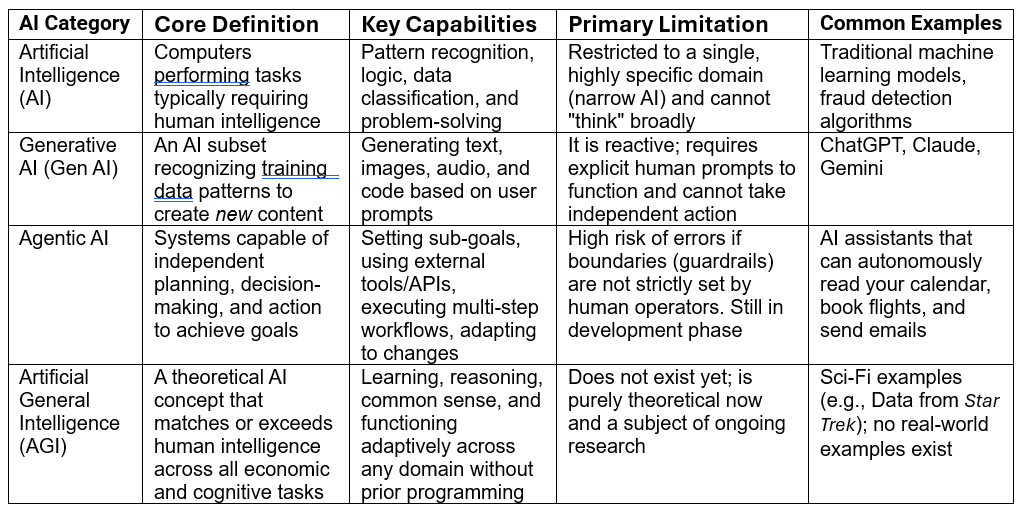
Types of AI - Generative, Agentic, and Artificial General Intelligence
Harnessing AI to SMEs:
As discussed above, increasing AI adoption among SMEs faces significant barriers from compliance concerns and legal costs; implementation challenges arising from clean processes and data; input prompt accuracy and output handling; integration of AI technology with legacy infrastructure; training and upskilling the organization for AI use.
We now briefly address how to overcome these challenges.
Compliance and legal: Understand local and relevant laws and potential impacts of the use of AI. Correlate them with AI tools needed for business use and a monitoring process needed for compliance. Create an awareness of potential jeopardies with business case use of AI. While it will incur additional costs, it is necessary to prevent future legal and compliance violations for a technology that is entering the workplace.
Implementation: AI business success needs clean data, which are created by clean processes. A prerequisite of successful AI implementation is a priori process analysis and data needs in association with an AI strategy - what is the objective, why is AI needed, where is it needed, how will it be done, by when, and what results are expected. This should be an exercise in identifying fits and gaps in various areas: compliance, current business process re-engineering needs, data cleansing needs, technology integration needs, and training and upskilling needs.
Training and upskilling: From the sources cited above, many organizations report organic use of AI and AI self-learning among staff. A structured AI training and learning approach will enhance optimal AI deployment success. The following areas, while not all inclusive, should be considered in training:
· Understanding the basics of AI.
· Key capabilities and limitations.
· Process and data requirements.
· Prompt input accuracy.
· Validating output for accuracy, hallucinations, and assumed user personas.
· Role specific workflows and how to create them.
· Change management and impact on workforce.
Conclusion
In this article we reviewed the current state of AI applications in SMEs and the business impact. There is significant growth in AI deployments and operational improvements. There are also critical success barriers, such as compliance and legal non-readiness, implementation choke points, and training and reskilling gaps. It is hoped that a methodical and sustained remediation of these barriers will further the use and benefit of AI to SMEs.
Supply Chain Solutions Unfit for SMEs
Supply chain software absorbed hundreds of billions in investment over two decades. SME disruptions are up 38% year-over-year. The math is not complicated — the industry just never wanted to do it.
It’s Thursday morning. A container has been sitting in Long Beach for eleven days and nobody in your logistics chain knows why. Your procurement manager is fielding calls from a retail buyer whose shelves are going empty. You’re looking at three systems — your ERP, your freight forwarder’s portal, your supplier’s email thread — none of which are talking to each other. None of which saw this coming.
You improvise. You absorb the loss. Two months later, it happens again. This is not a story about an SME that needs better operational discipline. It is a story about an industry that spent two decades building solutions for the customer with the biggest IT budget — and made a deliberate decision to let everyone else manage the rest themselves.
The Question the Industry Keeps Avoiding
If those tools are so good, why do the problems keep growing?
The evidence is overwhelming of a massive dysfunction between deploying the tools and achieving business results. We have discussed this dysfunction landscape and causes in an earlier article and present some key statistics below.
86% of SMEs experienced supply chain disruptions last year. Disruption frequency increased 38% year-over-year in 2024, with Resilinc’s EventWatchAI documenting over 22,500 discrete events globally. Disruptions cost companies an average of 8% of annual revenues; major production disruptions reached 30–50% of annual EBITDA. And $1.2 trillion in sales is erased each year due to stockouts alone — not from pandemics or geopolitical crises, but from products that failed to arrive because nobody had a unified picture of where it was.
McKinsey found that 45% of senior supply chain executives have no upstream visibility beyond their first-tier suppliers. For a Fortune 500 company that is painful but survivable. For an SME, it is existential. 45% of SME operators report losing nearly half their monthly revenue after a single disruption. They do not have a war room. They have a Thursday morning.
The Rational Decision That Became a Structural Failure
The failure here is not negligence. It is incentivized. A Fortune 500 deployment means a multi-year, multi-million-dollar engagement with predictable renewal revenue. SMEs present the inverse on every dimension. So, the industry made a rational choice: serve the enterprise, offer hand-me-downs to the mid-market, and let SMEs manage the rest themselves. However, history shows intentional or obtuse negligence of innovation or trends results in catastrophic business failures.
In 1975, Kodak’s own engineer demonstrated the first digital camera. Executives chose not to sell it — it would eat into film revenue. In 2000, Blockbuster laughed when Netflix offered to sell for $50 million. The supply chain industry made the same rational decision and walked into the same trap.
Adoption rates for supply chain software among SMEs sit between 25–40%; satisfaction scores hover around 50%. A structured benchmarking of twelve incumbent mid-market vendors found that each one covers one to three of the PLAN, SOURCE, MAKE, DELIVER, RETURN lifecycle stages. Not one addresses the full chain in a unified, sensing-adapting system. Not one was built for a business that cannot afford specialists to stitch it together.
The Architecture Problem Incumbents Can’t Solve
Incumbents are not ignoring AI. They are adding copilots to dashboards and chatbots to TMS portals. But bolting AI onto a legacy architecture is categorically different from building the architecture that makes AI the operational backbone of the entire system. Traditional supply chain software was built on one premise: software augments human labor, revenue scales with headcount. Rebuilding that as an outcome-based, continuously-sensing intelligence system means cannibalizing existing per-seat revenue before the new model matures. The incumbents know it. That is precisely why they won’t do it. It is the Kodak trap, dressed in a different decade.
The White Space and Why It Won’t Wait
A review of twelve active VC portfolios finds investment concentrated almost entirely in PLAN, SOURCE, MAKE, DELIVER, RETURN segment-specific solutions. Not one covers all five supply chain lifecycle stages with integrated intelligence. Not one is structured around a model where the platform wins only when the client wins — the same structural bet the incumbents made.
The market on the other side of that absence: SME global trade exceeding $2 trillion annually, a serviceable addressable market above $200 billion, and a capturable segment representing $2 billion in near-term revenue. A market not waiting to be educated. It already knows the system is broken and has been absorbing the cost for twenty years.
Building and running a global supply chain teaches something no market research captures: the failures are not dramatic. They are incremental — Tuesday’s problem, Thursday’s crisis, next quarter’s margin erosion. A hundred improvisations, each costing something, compounding into structural drag on businesses otherwise doing everything right. Complexity does not get simpler by adding more complexity to it. The answer is not another point solution on a fragile stack. It is a fundamentally different architecture — built from the beginning to sense, adapt, and protect continuity across the entire chain.
The companies building that architecture now will define the standard. The ones waiting for it to become obvious will find themselves buying access to someone else’s.
The supply chain industry has had two decades to ask the one question that mattered. It kept answering a different one. That changes now.
The $2 Trillion Blind Spot…
It All Begins Here
If Existing Solutions Were So Good - Why Do the Problems Keep Growing?
The SME supply chain market has been ignored and abandoned. One company finally asked the uncomfortable question and build what nobody else has.
In every supply chain disruption, you have read about in the last five years, SMEs absorbed the damage with spreadsheets, broken processes, fragmented partners, systems and tools, and hope. The experts analyzed. The incumbents upsold. The headlines moved on. And the problems got worse.
This is not an accident. It is the consequence of an entire industry optimizing for the large enterprise customer.
The global supply chain industry is full of deep domain experts. What it has never had is someone willing to step outside and ask: if existing solutions were so good - why do the problems keep growing?
The Damage Is Not Theoretical
Let us be precise about who is paying the price. The $2 trillion SME segment, CPG brands, industrial manufacturers, businesses spanning every sector and collectively moving trillions in goods annually, has been completely abandoned by an industry that claims to serve global trade.
The numbers are not projections. They are current operating reality:
86% of SMEs have experienced supply chain disruptions
45% lose nearly half their monthly revenue after a single disruption
$1.2T in sales erased annually due to stockouts alone
37% year-over-year increase in supply chain disruptions, still climbing
These are not edge cases. This is prevalent across SME global trade. And the solution the industry has offered them are point solutions that treat symptoms without curing the disease, expensive solution customizations, and the implicit suggestion that SMEs simply do not deserve better.
The Real Problem Is Fragmentation - And Everyone Is Selling Pieces
Walk the floor of any supply chain conference. You will find solutions for logistics, or procurement, or payments, or risk intelligence, never all of it, never unified, never designed for a business that cannot afford a dedicated IT department to stitch it together.
That fragmentation is not a gap. It is the moat incumbents have built around themselves. Monolithic enterprise architectures cannot profitably serve SMEs. They know it. They have made peace with it. They have moved on.
The SME Total Addressable Market is underestimated precisely because everyone with resources gave up on it. That is not a market problem. That is an opportunity.
Incumbent solutions, complacent with a large enterprise market have strategically left a $2 trillion addressable market on the table. History has a name for that kind of thinking: Complacency. Complacency kills. Kodak had it. Blackberry had it. Blockbuster had it. The graveyard is crowded.
What Defiance and Defensibility Actually Looks Like
By 2030, adaptive supply chain intelligence will be the core operating layer of any competitive business, not optional software, not a dashboard bolted onto a legacy ERP. The companies that will establish themselves as the defining platform for this new era are being built right now.
MySource.Global was not built to iterate on what exists. It was built because what exists is failing, visibly, measurably, year over year, and the people absorbing that failure deserved something fundamentally different.
Building at the intersection of AI, global supply chains, insurance, payments, and finance is an uncommon combination. Years of development in these overlapping domains have produced proprietary integrated workflow intelligence and an adaptive architecture that incumbent supply chain and technology players cannot replicate quickly.
The platform is AI-powered, systemically integrated, modular, and human-first. It pre-emptively senses disruptions, from geopolitical conflict to local equipment failures, before they surface as crises and executes alternate plans with a single approval. It integrates into what SMEs already have. It does not replace it. It makes it intelligent.
Each module solves a discrete, documented pain point. From a neuroeconomic standpoint, that is not an accident, solve the first problem, and you are embedded. Every subsequent module deepens the relationship, unifies internal and external partner processes, while protecting capital outlays. MySource.Global is the intelligence layer inside the supply chain. The intel inside, for the SME market.
This is not positioning language. It is how it is architected and built.
The Signal the Market Is Already Sending
MySource.Global is at MVP stage. Pre-revenue. And already fielding unsolicited inbound demand, prospective CPG and industrial clients asking when the platform will be ready, without a single dollar spent on outbound sales.
That is market pull before the door has opened. It is the kind of signal that does not get manufactured by a pitch deck.
The serviceable market exceeds $200 billion. The immediately capturable segment, the 1% of global SMEs currently underserved and actively looking for exactly this, represents $2 billion with no meaningful competition. The total addressable opportunity exceeds $2 trillion, underestimated specifically because the players with resources decided it was not worth their attention.
By the time any large player pivots to try, MySource.Global will already be the standard - embedded, compounding, and irreplaceable.
Why This Moment Is Now
The forces fracturing global supply chains, geopolitical volatility, climate shocks, demand unpredictability, accelerating product cycles, disconnected systems, data, and processes, are not temporary conditions. They are the permanent operating environment. By 2030, adaptive supply chain intelligence will be the core operating layer of any competitive SME, not optional software, not a bolt-on dashboard.
The companies defining that standard are being built right now. The window to lead it does not stay open.
MySource.Global is raising $5 million to complete platform development, deploy with its first clients, and establish an initial market scale. Not to validate the thesis, the demand already did that. To close the gap between where the platform is and where the market is already pulling it.
The Team
This is a problem that requires a rare combination of expertise to solve: supply chain operations, artificial intelligence, global finance, payments infrastructure, insurance, and entrepreneurial execution. Our team has lived and operated at these intersections, not theoretically, but in practice, at scale, and in the markets, we are targeting.
The industry had decades to solve this. It chose not to.
Someone finally did.