
AI and SMEs
Introduction
In an earlier article we reviewed the current global supply chain landscape, rife with disruptions, and how Small and Medium Enterprises (SMEs) with limited resources are being severely impacted. We also exemplified with data how current supply chain solutions are unfit for purpose for SMEs. Current investments in supply chain are also focused on furthering the point solutions embellished with AI add-ons. Our conclusion remains that SMEs need a disruption-avoidance supply chain solution suited to their requirements. Such a solution, with a foundational human-supervised AI backbone, must integrate all stakeholders and operate on clean processes and data.
The critical question in enabling SMEs with AI solutions is this: what are the challenges in harnessing and adapting SME environments to AI applications, where are the gaps, and what will be necessary for successful projects? This article provides directions and answers to these questions. First, however, we will review the current state of AI use in SMEs.
AI Applications in SMEs
Business Use and Impact:
According to the U.S. Chamber of Commerce, nearly 60% of small businesses report using AI and generative AI for operational purposes, more than doubling their usage from recent years. An OECD report indicates 30.7% of surveyed SMEs have integrated generative AI actively into their workflows. The regional divide is also evident from a Sage Group Study which notes that while the US (64%) and the UK (60%) lead in micro-business AI integration, other regions like France (35%) are adapting at a slower pace. Newer startups are integrating AI into their core operations much faster. A JPMorgan Chase Institute Report highlights that cohorts of new small businesses reached a 10% AI adoption rate in just six months, compared to six years for older counterparts. While lower entry costs have increased access, broader adoption may require addressing skills gaps through AI skills training, building trust through transparency and responsible adoption frameworks, and ensuring a robust ecosystem of AI service providers that can meet diverse business needs. In summary, there is: (i) rapid growth in SME AI usage; (ii) increased use of generative AI; (iii) growing operational use; and (iv) a faster rate of AI adoption.
A global survey by Salesforce found that 91% of SMEsusing AI report that it successfully boosts their top-line revenue. While data is promising, it is debatable, as various other reports indicate limited top-line impact with focus primarily on operational efficiency gains. A British Chambers of Commerce report contradicts the prevailing workforce-reduction narrative; it found 95% of SMEs using AI report no reduction in headcount, indicating that these tools are augmenting workers rather than replacing them.
AI Adoption Issues:
We now consider the key AI adoption challenges for SMEs. They are:
Regulatory Compliance Concerns: 65% of small businesses express concern over a confusing patchwork of state-level AI laws and how it impacts their use of AI tools.
Increased Legal Costs: As a result, SMEs worry about skyrocketing legal and operational compliance fees. 76% of small businesses in Colorado and 86% in Hawaii fear these policy-driven expenses.
Regulatory Restrictions: Government limitations or bans on technology present a serious threat to small business survival, with 77% of SMEs stating that restrictions on AI would negatively impact their daily growth, operations, and bottom lines.
Persistent Structural Barriers: Despite growing awareness of AI's benefits, typical adoption barriers like initial implementation costs, data privacy concerns, and lack of technical expertise persist. [US Chamber of Commerce]
Deployment of AI is also critically dependent on data accuracy, workflows redesigned to produce clean data, workforce skills, and integration. Specifically, these are:
Prompt Engineering & Output Literacy: Staff must transition from standard search habits to structured prompt design and learn how to critically vet and verify AI outputs to prevent hallucinated errors.
Hygienic Data: Employees must learn basic data hygiene. AI is only as good as the internal data it feeds on; teams require training on how to correctly structure documents and tag metadata. In turn, clean processes are needed for clean data.
Role-Specific Workflows: Departments need custom playbooks for each workflow. Marketers require training on AI asset generation, while finance teams need coaching on automated anomaly detection.
The "People Element" Challenge: SMEs must not implement systems prematurely without investing in change management to ease staff fears of automation.
Integration: The technical bottleneck for most small businesses is connecting modern AI with aging internal infrastructure. These obstacles stem from legacy systems lacking open API capabilities, siloed data, manual processes, custom integration middleware overhead, and fragile cybersecurity.
We next review briefly the difference between AI, Generative AI, Agentic AI, and Artificial General Intelligence (AGI). The following table shows the key differences.
Types of AI:
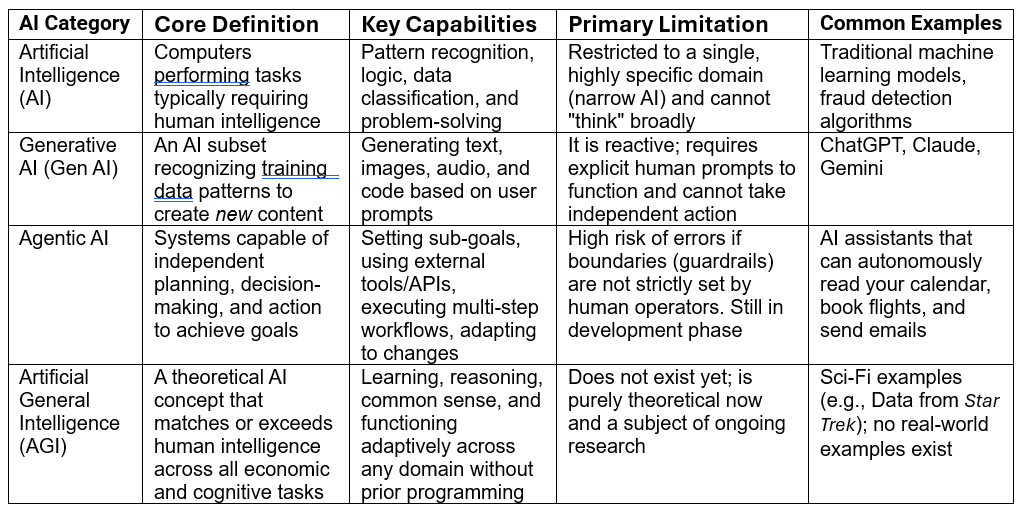
Types of AI - Generative, Agentic, and Artificial General Intelligence
Harnessing AI to SMEs:
As discussed above, increasing AI adoption among SMEs faces significant barriers from compliance concerns and legal costs; implementation challenges arising from clean processes and data; input prompt accuracy and output handling; integration of AI technology with legacy infrastructure; training and upskilling the organization for AI use.
We now briefly address how to overcome these challenges.
Compliance and legal: Understand local and relevant laws and potential impacts of the use of AI. Correlate them with AI tools needed for business use and a monitoring process needed for compliance. Create an awareness of potential jeopardies with business case use of AI. While it will incur additional costs, it is necessary to prevent future legal and compliance violations for a technology that is entering the workplace.
Implementation: AI business success needs clean data, which are created by clean processes. A prerequisite of successful AI implementation is a priori process analysis and data needs in association with an AI strategy - what is the objective, why is AI needed, where is it needed, how will it be done, by when, and what results are expected. This should be an exercise in identifying fits and gaps in various areas: compliance, current business process re-engineering needs, data cleansing needs, technology integration needs, and training and upskilling needs.
Training and upskilling: From the sources cited above, many organizations report organic use of AI and AI self-learning among staff. A structured AI training and learning approach will enhance optimal AI deployment success. The following areas, while not all inclusive, should be considered in training:
· Understanding the basics of AI.
· Key capabilities and limitations.
· Process and data requirements.
· Prompt input accuracy.
· Validating output for accuracy, hallucinations, and assumed user personas.
· Role specific workflows and how to create them.
· Change management and impact on workforce.
Conclusion
In this article we reviewed the current state of AI applications in SMEs and the business impact. There is significant growth in AI deployments and operational improvements. There are also critical success barriers, such as compliance and legal non-readiness, implementation choke points, and training and reskilling gaps. It is hoped that a methodical and sustained remediation of these barriers will further the use and benefit of AI to SMEs.